Battery life
How long does a heated jacket last? Battery life explained
How long a heated jacket or gilet runs on a power bank: mAh and watt-hours, heat settings, cold weather, flying with a power bank and ways to make it last.

The short answer: a heated jacket or gilet running from a 10,000 mAh power bank usually gives you somewhere between 4 and 10 hours of heat, depending on the setting. The longer answer depends on three things: how much energy the power bank really holds, how much power the heating pads draw, and how cold it is outside. This guide explains each one, so you can work out the run time for any jacket and any power bank.
How a heated jacket works
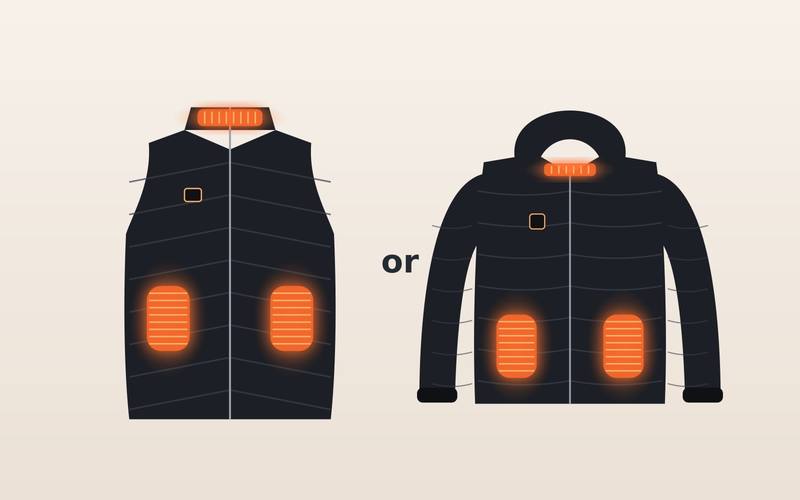
A USB heated jacket is a normal padded jacket with thin carbon fibre heating elements sewn into the lining. On our 9-zone heated puffer jacket there are nine heated areas spread across the front, the back and the collar. A short lead with a USB-A plug sits in a pocket. You plug it into a power bank, hold the button on the chest to switch the heat on, and press again to change the setting.
There are three settings. The supplier lists them as roughly 45°C (warm, red light), 35°C (comfort, white light) and 25°C (energy saving, blue light). The 9-zone heated gilet works the same way, with heated areas at the collar, the upper back, the back, the abdomen and the waist.
The power bank is not included with our jackets and gilets. Any USB power bank with a USB-A socket will run them, because the heating runs at the standard USB voltage of 5 V. Our heated gloves and socks are different: they come with their own rechargeable batteries.
What the suppliers quote
These are the run times the suppliers give for their garments on a 10,000 mAh power bank. They are the makers' figures, not our own tests.
| Garment | Setting | Supplier's figure |
|---|---|---|
| 9-zone heated gilet | Warm | 4 to 6 hours |
| 9-zone heated gilet | Comfort | 6 to 8 hours |
| 9-zone heated gilet | Energy saving | 8 to 10 hours |
| 9-zone heated jacket | Not stated | Up to 8 to 12 hours |
The jacket figure is a single range without a setting, so read it as the best case on a low setting. On the warmest setting, expect something closer to the gilet's warm figure.
mAh, volts and watt-hours
Power banks are sold by milliamp-hours (mAh), but mAh on its own does not tell you how much energy is inside. For that you need watt-hours (Wh):
Wh = mAh × volts ÷ 1,000
The voltage to use is the voltage of the lithium cells inside, which is 3.7 V for most power banks, not the 5 V that comes out of the USB socket. The 10,000 mAh power bank we sell is labelled 10,000 mAh at 3.7 V, which works out at:
10,000 × 3.7 ÷ 1,000 = 37 Wh
A 20,000 mAh bank at 3.7 V holds 74 Wh.
Conversion losses
Not all of those 37 Wh reach the jacket. The bank has to raise the 3.7 V of the cells to the 5 V of the USB socket, and some energy is lost as heat along the way. The maker of our power bank states a conversion efficiency of over 70 percent. Taking 70 percent as a cautious figure, about 26 Wh of the 37 Wh is left to heat the jacket.
Working out the run time yourself
Once you know the usable watt-hours, the maths is one division:
Run time in hours = usable Wh ÷ power drawn in watts
Few heated jackets state their power draw, so the table below uses example figures. They are not measurements of our products; they show how the numbers move.
| Example power draw | 10,000 mAh bank (about 26 Wh usable) | 20,000 mAh bank (about 52 Wh usable) |
|---|---|---|
| 3 W | about 8.5 hours | about 17 hours |
| 5 W | about 5 hours | about 10 hours |
| 7 W | about 3.5 hours | about 7.5 hours |
| 10 W | about 2.5 hours | about 5 hours |
You can also run the sum backwards. If the gilet gives 4 to 6 hours on warm from about 26 Wh, its average draw on that setting works out at roughly 4 to 6.5 W. On energy saving, 8 to 10 hours points to roughly 2.5 to 3.5 W. That fits with the table, and it shows why the lowest setting can more than double your time outside.
One more limit to know: the USB-A socket on our power bank gives up to 5 V at 3 A, which is 15 W. That is plenty for USB heated clothing.
Why cold weather cuts battery life
Lithium batteries do not like the cold. Battery University explains that cold temperature increases the internal resistance of a battery and lowers its capacity, and gives the example that a battery delivering 100 percent of its capacity at 27°C typically delivers only about 50 percent at minus 18°C. It also notes that, for lithium-ion, the loss only lasts while the cell is cold: warm it up again and the capacity comes back.
A British winter is rarely that cold, but a power bank in an outside pocket on a windy hillside can get much colder than the air feels. The jacket's own heat helps, which is why the lead sits in an inside pocket.
How to make the battery last longer
- Charge the bank fully before you go out. A bank left half full in a drawer will not give the times above.
- Start high, then turn it down. Use the warm setting to take the chill off, then drop to comfort or energy saving once you are warm.
- Keep the wind off. A waterproof or windproof shell on top holds the heat in, so a lower setting feels warm enough. Our guide heated gilet vs heated jacket explains how to layer each.
- Keep the bank in an inside pocket, close to your body, so the cells stay warmer.
- Switch off indoors. In a shop, a car or a pub you do not need the heat.
- Carry a second bank on long days. Two 10,000 mAh banks are easier to carry than one large, heavy bank, and you can swap them over.
- Look after the rest of your kit. Gloves, a hat and dry socks matter as much as the jacket. See how to stay warm outdoors in a UK winter.
Heated gloves and socks have their own batteries
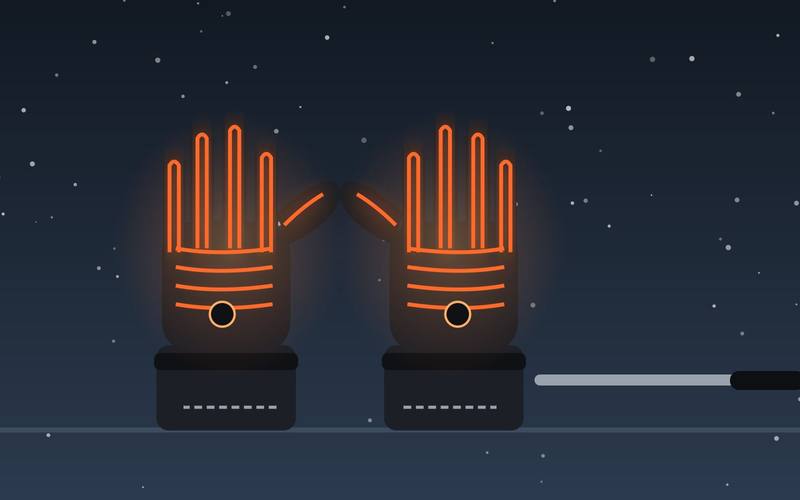
Gloves and socks do not use a power bank. The heated ski gloves come with battery packs that the supplier lists as 5000 mAh, which sit in zipped pockets at the cuffs. The thinner heated finger gloves have a built-in rechargeable battery that the supplier lists as 3000 mAh. The heated socks come with two 4000 mAh packs: the supplier quotes 3 to 6 hours of heat and about 3.5 hours to charge them. The same rules apply: start low, keep the packs warm, and charge them fully before a day out.
Flying with a power bank
If you take a heated jacket on a skiing trip, the jacket can go in any bag, but the power bank cannot. The UK Civil Aviation Authority says:
- always keep power banks with you in the cabin, and never pack them in checked luggage, because they can overheat and cause a fire
- you can take two power banks per person
- power banks must not be recharged on board
- items from 100 Wh to 160 Wh need airline approval, and anything over 160 Wh is not allowed in passenger baggage
A 10,000 mAh bank at 37 Wh and a 20,000 mAh bank at 74 Wh are both below 100 Wh. Airlines can set their own limits, so check with yours before you fly.
Choosing a power bank for heated clothing
For a jacket or gilet, look for a bank with a USB-A socket and a capacity of around 10,000 mAh. It fits in the inside pocket, it covers a dog walk, a match or a commute with plenty to spare, and it charges a phone too. A display that shows the charge left is useful, because you can see at a glance whether there is enough for the walk home. Our 10,000 mAh power bank has a USB-A socket for the jacket lead, built-in USB-C and Lightning cables for a phone, and a USB-C input for charging.
Before you wash your jacket, unplug the bank and take it out: how to wash heated clothing covers the rest.
Frequently asked questions
How long does a heated jacket last on a 10,000 mAh power bank?
It depends on the heat setting and the weather. The supplier of our 9-zone jacket quotes up to 8 to 12 hours from a 10,000 mAh power bank, and the supplier of our 9-zone gilet quotes 4 to 6 hours on warm, 6 to 8 hours on comfort and 8 to 10 hours on energy saving. Expect less on the highest setting in hard frost.
How do I work out the battery life of a heated jacket?
Turn the power bank's capacity into watt-hours (mAh times 3.7, divided by 1,000), take off the conversion losses, then divide by the power the jacket draws in watts. A 10,000 mAh bank holds 37 Wh, and if around 70 percent of that reaches the jacket, a heater drawing 5 W runs for about 5 hours.
Does cold weather drain a power bank faster?
Yes. Cold raises the internal resistance of a battery and lowers the capacity it can deliver. Battery University gives the example of a battery that delivers 100 percent at 27°C delivering only about 50 percent at minus 18°C. Keep the power bank in an inside pocket, close to your body.
Can I take a power bank for my heated jacket on a plane?
Yes, in your hand luggage only. The UK Civil Aviation Authority says power banks must never go in checked luggage, limits passengers to two power banks each, and says banks from 100 Wh to 160 Wh need airline approval. A 10,000 mAh bank is 37 Wh.